


Small by Design, Mighty by Impact: Webb Institute Returns to U.S. News Rankings and Debuts at No. 3 in the North & No. 2 among Private Colleges in the Region
by Kaye Lin, Director of Communications and Marketing
For years, standard higher education ranking engines prioritized institutional size, applicant volume, and traditional resource models – metrics that systematically left Webb Institute on the sidelines. Despite boasting a 100% career placement rate, an elite dual-degree engineering curriculum, and a four-year full-tuition scholarship for every admitted U.S. student, Webb’s intentionally tight-knit cohort of just over 100 undergraduates meant the college didn’t meet the minimum survey thresholds to be scored.
That landscape just underwent a major shake-up.
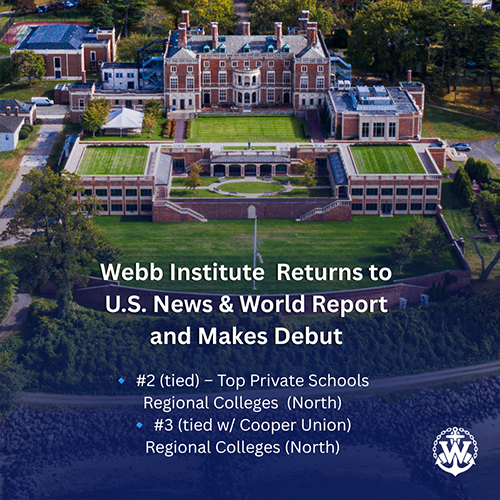
In the newly released U.S. News & World Report 2027 Best Colleges edition, Webb Institute has officially returned to the national spotlight, making an entrance tied for No. 3 among Regional Colleges (North) and No. 2 among Top Private Schools. The tie places Webb shoulder-to-shoulder with one of the most celebrated names in engineering and design: Manhattan’s Cooper Union.

The Outcome-Driven Methodology Shake-Up
Webb’s return coincides with a fundamental realignment in how U.S. News evaluates higher education. Responding to widespread demands for genuine return on investment and institutional accountability, the publication has dramatically revamped its scoring formulas to prioritize post-graduation outcomes, social mobility, and long-term financial security – particularly for students with significant financial need.
Outcome measures now account for more than 50% of an institution’s overall score. In this latest edition, the publication reinforced that focus by introducing metrics like “Earnings by Major,” tracking federal financial aid recipients four years into their careers.
As LaMont James, Managing Editor for Education at U.S. News, stated on the publication’s strategy: “We made these changes to better reflect career outcomes, which is so important to students who are making this investment. Ultimately, that’s what matters most. The best college is the one that ultimately aligns with the student’s personal, academic, and financial priorities. ”
For Webb Institute, this shift isn’t a new goalpost to scramble toward. It is the very model the college was founded on in 1889.
“Our return to the U.S. News rankings isn’t because Webb changed its model,” stated Mark Martecchini, President of Webb Institute. “It’s because the broader higher education landscape is finally measuring what matters most: student success, minimal debt, and real-world outcomes.”
Two Historic Missions, One Rare Distinction
The tie between Webb Institute and The Cooper Union at No. 3 is a moment rich with historical resonance.
Both institutions were born out of 19th-century industrial philanthropy: Peter Cooper established The Cooper Union in 1859 to make quality education “open and free to all,” while master shipbuilder William H. Webb established Webb Institute thirty years later with a parallel vision to educate maritime leaders without tuition barriers.
While financial pressures eventually led Cooper Union to introduce partial tuition in 2014 as it works through a long-term plan to restore full coverage, Webb’s founding pledge remains unchanged. Every enrolled U.S. citizen and permanent resident at Webb continues to receive a full-tuition scholarship, funded by an endowment carefully stewarded for more than a century.
Yet while Cooper Union enrolls nearly 1,000 students across art, architecture, and engineering in the heart of New York City, Webb remains ultra-focused: a single waterfront campus in Glen Cove, just over 100 total undergraduates, and a single, rigorous dual Bachelor of Science in Naval Architecture and Marine Engineering.
Why the New Metrics Favor Webb
Webb’s showing across the 2027 rankings – including a tied No. 123 among all Non-Doctorate Undergraduate Engineering programs nationwide – proves that small-scale focus can compete with large research universities:
- Minimal Debt, High Starting Salaries: Because every student receives a full-tuition scholarship, with need-based scholarships available for other college costs, Webb graduates enter the maritime, renewable energy, and defense sectors free from burdensome debt, positioning them for immediate upward financial mobility.
- 100% Career and Graduate Placement: Webb undergraduates participate in four mandatory Winter Work Terms – internships in shipyards, ship design firms, and sailing aboard working ships across the globe. Coupled with industry partnerships that reinforce technical innovation in the curriculum, 100% of seniors secure career placement or graduate admission by commencement day.
- Industrial Immersion: The curriculum integrates theoretical study of ship design with practical exposure to ship production and operations, turning out engineers who can design ships that best meet their working requirements.
For Webb, tying at No. 3 isn’t a destination, it’s an affirmation. In a higher education landscape finally realigning around career outcomes and financial well-being, Webb has never had to pivot. The compass hasn’t moved; the rest of the world is just steering in the right direction.
Small by design, unmatched in impact, the Webb experience proves that when educational access and academic rigor meet, extraordinary things take shape on the water.
To view Webb Institute’s official 2027 rankings and profile data, visit US News & World Report at:
https://www.usnews.com/best-colleges/webb-institute-2900/overall-rankings
More posts you may be interested in.